


FELLOWSHIP NEWS
AND REPORTS FOR MAY/JUNE 2026
COMING UP THIS WEEK
May 24-30, 2026
Sunday, May 24:
•Service at 10:30 a.m. in person and on Zoom. Guests Nels Gullerud and Walter Hodgdon present a service titled “Mindfulness, Patience, and Compassion.”
•Special Collection for Hope Family Services ends today.
Tuesday, May 26:
•Connections: A Sharing Hour has its weekly meeting at 11 a.m. Facilitated by Alia Starkweather. All are welcome.
•Earth Spirit Group meets today 12:30 p.m. to 2 p.m. and continues on the 2nd and 4th Tuesdays of each month. Ancient pagan/Goddess and Earth-centric myths and spirituality are explored. Participants share in research and presentation. Contact Peggy Dickson for more info.
Wednesday, May 27:
•Worship Team weekly meeting at noon on Zoom.
•Board meeting at 6:30 p.m. in person with Zoom option.
Thursday, May 28:
•Joyful Jammers meets every Thursday from 10 a.m. to noon. Anyone who plays an instrument or sings is welcome to join in the fun! Contact Peggy Dickson for more info.
•NOTE: Chair Yoga on Thursday evenings will resume in the fall.
Friday, May 29:
•Annual Report booklets available to members and friends.
COMING SOON
•RESCHEDULED! June 14: Annual Congregational Meeting following the Sunday service. Vote on budget and leadership for 2026-27.
ONGOING
•Menstrual Supplies Drive: We are collecting these for Kim’s Krew clients. See wicker hamper near fireplace in Social Room. A sign lists what is needed. Gift cards and cash welcome; please deposit in little black container there. Thank you!
NOTE: All activities are in person at the Fellowship unless otherwise indicated.
Schedule updated as of May 23, 2026.
SOCIAL EVENTS FIRST WEDNESDAY, THIRD FRIDAY OF EACH MONTH
Join us for our next ‘happy hour’ at Pier 22 (1200 1st Ave. W, Bradenton) on Wednesday, June 3, at 4:30 p.m. Everyone is welcome to join this informal gathering featuring friendship, food, drink , and conversation. Go to pier22.com for directions and menu information. Our Pier 22 outing is held the first Wednesday of each month.
Our next monthly Share a Dish potluck is on a special date this month: Friday, June 19, at 6 p.m. Please sign up in the Social Room and let us know what dish you are bringing.

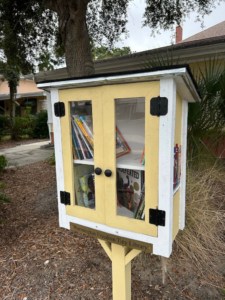
OUR TINY LIBRARY IS A SUCCESS!
In November 2024, we dedicated our Tiny Library. Since then, we have given away over 500 books focused on Diversity, Equality, Inclusion, and UU Values, as well as banned books. We also included books in other languages that are spoken in our neighborhood. In the political atmosphere we are living in, it’s a way we can stand up to the censorship and be a voice for the marginalized. Our Tiny Library has been embraced in other ways by our community. I often find books that have been placed in the cabinet. I remove them and review them for content and condition and usually put our bookplate and bookmark in them, catalog them, and put them back out to be circulated to the public.
The Warmington Freedom Tiny Library should be a source of pride for our community. It’s funded by a special account set up by the late Carl Warmington in honor of his wife Ruth. I belong to a Tiny Library Facebook group and I read complaints that no books are being taken, all the books being taken, and even vandalism. So far none of that has happened to us. Our cabinet has recently weathered 3 hurricanes thanks to the sturdy construction from our former custodian Bernie Salzinger and it has a motion sensor light inside installed by Denise Solomon our office assistant and custodian. It was decorated by Chris MacCormack who painted the books on the side. I’m excited about how successful our Tiny Library is.
Donations of books are welcome from the membership if you’d like to support the cause. Planned enhancements are; a bench next to it and a literature tube that we can put a brochure about our Fellowship in it for the public to take to learn about us. The Tiny Library is an outreach to the neighborhood, a symbol of our principles, and a way we can try to make a difference by spreading a message.
— Becky Smith
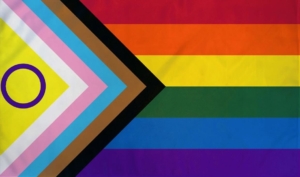
ABOUT THE PROGRESS PRIDE FLAG
The original pride flag was created in the 1970s by gay activist Gilbert Baker, friend of Harvey Milk, the first openly gay man to be elected to public office in California. Baker used eight colors and corresponding meanings: hot pink for sexuality, red for life, orange for healing, yellow for the sun, green for nature, turquoise for art, indigo for harmony, and violet for spirit.
The new Progress Pride Flag includes new colors and a new design that are meant to represent people of color, as well as people who are transgender, intersex, or nonbinary.
The colors black and brown were added to the Progress Pride Flag to represent unrepresented black and brown people.
With the rise of the Black Lives Matter movement, culture at large began to shift in a much-needed way towards acknowledging the vital roles that people of color have had in our society. The pride movement background is one of many areas where people of color did not receive the recognition they deserved historically. Adding colors to represent them on the flag is one way to change that.
The word “progress” in the new flag isn’t only about adding the new colors to it. It’s also because of the shape, which differs from the original design of horizontal stripes only. The Progress Pride Flag shows the white, pink, baby blue, black, and brown stripes in a triangle shape, with the old six-color rainbow stacked next to them.
The color placement and new shape was done intentionally to convey the separation in meaning and shift focus to how important the issues represented on the left are.
The placement of the new colors in an arrow shape is meant to convey the progress still needed.
— Mariano Vera
[As a Welcoming Congregation accredited by the Unitarian Universalist Association, Manatee UU Fellowship flies the Progress Pride Flag in front of our building each Sunday morning. It also appears on our permanent building sign.]
RENEWING OUR LEGACY CIRCLE
Anyone can join our Legacy Circle and make meaningful gifts to Manatee Unitarian Universalist Fellowship in their will. Regardless of the amount, your bequest is a statement of faith that our UU movement and our voices for compassionate justice, democracy, and religious freedom are heard long after we are gone. When you demonstrate that you care enough about this fellowship to support its future, others will follow your generous example.
No matter what your age, you can designate Manatee UU Fellowship as the beneficiary of all or a percentage of your IRA and it will pass to us tax-free after your lifetime. It’s simple, just requiring that you contact your IRA administrator for a change-of-beneficiary form or download a form from your provider’s website.
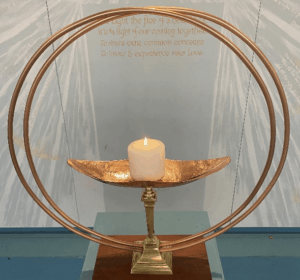
Join the Legacy Circle at our fellowship by stating your gift plan on your personal intentions form available in our office. Your name(s) will be placed on the Legacy Circle plaque in the sanctuary. Because most popular retirement plan administrators assume no obligation to notify charities of their client’s designations, the intentions form is an important document to us and will be held in a confidential file.
A GIFT FOR US ALL
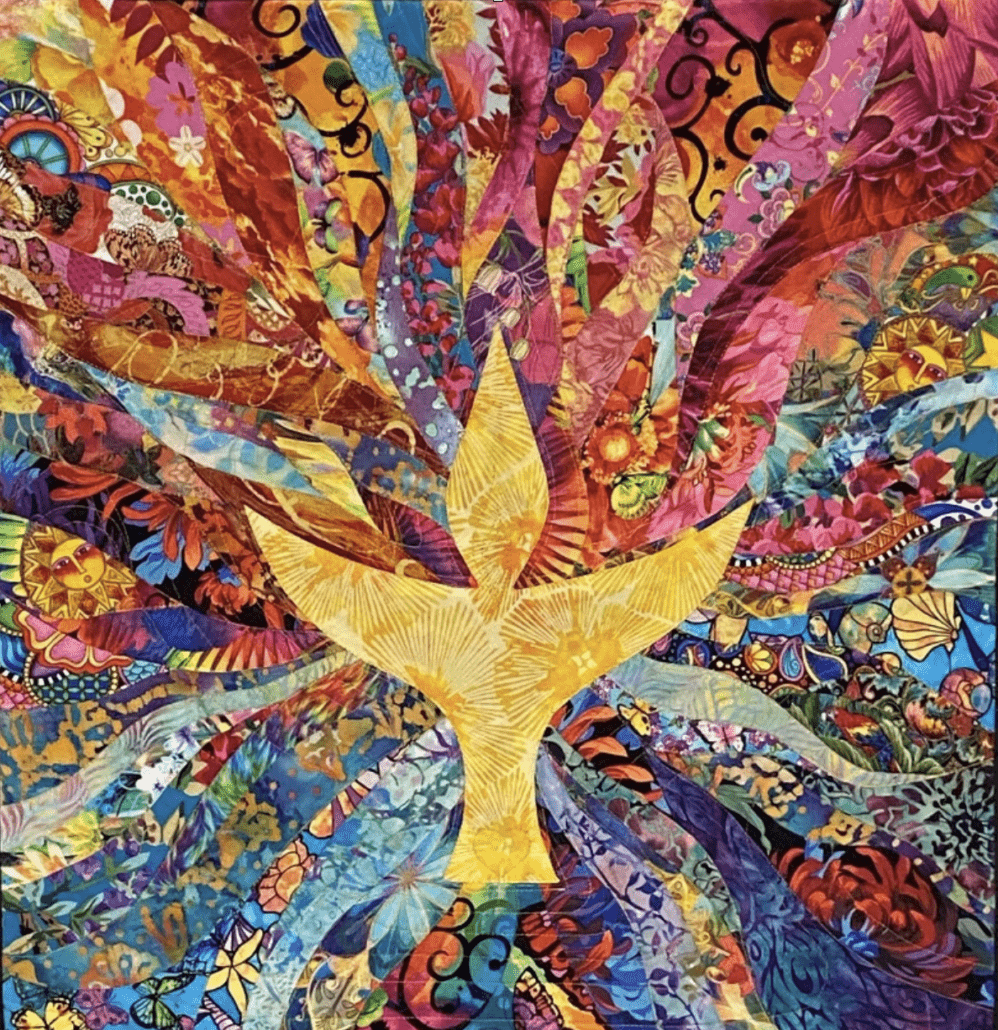
For our 2021 auction, Peg Green offered to create a flaming chalice fabric wall hanging “to hang in your home or give as a gift.” The winner would get to choose the flaming chalice design and color scheme. and then Peg would create the piece.
During the live auction held in February 2021, Bill Hayes kept raising his bid and finally outbid everyone. Over that summer he generously gifted the lovely quilt to our fellowship. It is bold and beautiful, and can be seen in our Sanctuary on Zoom as well as in-person during our Sunday services.
Peg’s artwork can be viewed on her website www.peacepeg.com and one of her works is on the cover of the UUA Pocket Guide for new members.
Thank you, Peg and Bill, for being so generous!

Reverend Fred L Hammond
FRED’S FLAVORINGS
There has been a lot of focus on religion and politics in the news lately. The most recent is newly converted Catholic Vice President Vance criticizing the Pope of his newfound faith on the Pope’s condemnation of the war in the Middle East. Without getting too deep in the weeds of this particular event, there is merit in examining the role of faith in politics.
Faith, in its broadest sense, is to be a guide on how individuals and groups live out their values. Living one’s faith also includes the political milieu in which one’s life is affected daily. Throughout history faith has had a symbiotic relationship with politics of the day.
Taoism talks about what makes for a harmonious society. This is political. Judaism has always had prophets of God who critiqued the political climate of the day. It is Judaism’s faith construct that informed the teachings of Jesus. His message was confrontational of the political powers of his day criticizing how the widow, the poor, the infirm, were exploited by the powerful. esus was crucified because his message of love for one another was a political threat to the empire.
When Christianity became the power of the state, they used their political power to suppress oppositional voices and to maintain control over the populace. While there were pockets of religious orders that separated themselves from those in power, they still remained political in the sense of caring for the poor, the orphans, the widows, etc. confronting again the exploitation by those in power.
The message of love for one another remains a political statement against those in power. To love one another means you do not enable political systems to exploit the poor by withholding basic human rights like water, food, shelter, health care. To love one another means you do not bomb schools, hospitals, residential homes, power plants, and water desalination plants. To love one another means welcoming the foreigner, embracing the diversity of humanity, recognizing the inherent worthiness of each person to live their best life. To love one another means you do not prevent health care for transgender, non-binary, and intersex individuals. To love one another means you do not restrict the voting rights of individuals because you fear they may vote against your positions.
These are all political issues. They are based in profound theological and moral groundings. The Pope, while I do not subscribe to the doctrines of his faith, has every right to voice the message of faith to his flock and to the world.
James Luther Adams, 20th-century Unitarian Universalist theologian, stated that an unexamined faith is no faith at all. He wrote his most influential essays during the rising threat of fascism in Germany in the 1930s and 1940s. The politics of his day impacted the expression of faith then. We find ourselves almost a hundred years later in a similar era where faith and politics are clashing. Will we find our faith as Unitarian Universalists worthy of this time and place? The politics of the day should cause us to examine our faith. The question for all people of faith is will we submit to our faith or submit to the power of the state?
Blessed Be.
I was talking with some colleagues about the use of the phrase ‘Beloved Community’ and how it is accepted in our congregations. But in the conversation another phrase came up that is becoming more frequent in our Unitarian Universalist lexicon. And that is the usage of the term ‘Beloved.’
Many Unitarian Universalists understand the phrase of Beloved Community as it was a term that was popularized by Rev. Dr. Martin Luther King, Jr. And it has been used to describe the community of believers in Christian terms. The word is synonymous with the phrases ‘Kingdom of Heaven,’ ‘Realm of God,’ and ‘Heaven on Earth.’
For Unitarian Universalists, it is the community where our values of justice, equity, transformation, pluralism, interdependence, generosity centered in love are manifested in their ideal state. In many ways it is an aspirational community, one that we strive to create. I think most of us get that concept, the aspirational state of where we all live in harmony with one another. I often think of “Star Trek: The Next Generation,” where Captain Riker tells someone that in the federation all of society’s problems —poverty, food insecurity, healthcare access, racism, all of the isms — have been removed from humanity’s experience.
I don’t experience anyone bristling with the use of the phrase ‘Beloved Community.’ But using the phrase ‘Beloved’, which is a natural extension of the Beloved Community, has often been met with resistance. I’ve often wondered why.
Some folks consider it too intimate. Others consider it as hokey or trite or simply downright false and therefore insincere. And I get that, I really do. But is there another reason why we might bristle when we hear our UUA President or another person address us as ‘Beloveds.’
We have been enculturated in a society where trauma and abuse from others is a daily occurrence. Love is experienced more as a conditional transaction than as an unconditional expression of being. ‘What have you done for me lately’ is an attitude that expresses this conditionality and this abuse. Love is withheld until another person has pleased us and then we bestow affection. Love as a transaction is a method of having control or power over someone else. Unconditional love is not about control or power over anyone or anything.
So many of our faith traditions have also reduced what is called god’s love into a transactional event. IF you accept this doctrine of belief THEN you will know love from this community of believers and if you do not then, not only will you be rejected by this community of believers, but you will be punished in the fires of hell for all eternity is the transactional message given. It is a form of emotional abuse and trauma.
This even translates into how we offer services to the indigent, the immigrant, and the infirmed. We decide who is worthy of such services, place sometimes impossible barriers to receive services and then find new ways to disqualify people from services all in the name of saving money. People’s lives are monetized into what their value is to the whole of society. We hear this every day, and it is emotional abuse and exerts power over others.
Our lives are filled with examples of emotionally abusive and transactional love that we become jaded in our perception of ourselves. We might have rejected the notion of original sin, but it is central to our society and how it measures out love and concern.
Unitarian Universalists recognize that the Beloved Community is in so many ways aspirational. But the good news is it’s an aspiration that can be seen in glimmers. If we knew in the center of our hearts that we were loved, unconditionally by our faith, imagine how that would transform us and the world.
I spoke a few weeks ago about the early Christian church as described in the Christian text of Acts of the Apostles. They were of one heart. If there was any need, it was filled by other’s resources. They knew they were beloved. They knew there was a love greater than themselves that was holding them. They were able to rest in that love, and their lives were made richer for it. May we come to know ourselves as beloved and experience love as unconditional in our beloved community now and in the days to come.
Blessed Be.
Several months ago, I began the process of deciding what I wanted to do with my estate in the event of my death. My priority is wanting my nephews and niece to be able to thrive in this world of pain and sorrow we are living in. My youngest nephew, especially, as he is diagnosed with paranoid schizophrenia, which is controlled through medications. He is on Medicaid and disability. He functions to the best of his ability and still has bouts of extreme paranoia. But if he is to thrive, then he needs to have some safety nets in place. His mental health is currently treated through Medicaid support, which enables him to be functional in society. We do not know if Medicaid is going to survive the Trump Administration. But if the administration does away with Medicaid support, then that functionality disappears. So, in thinking about what is important for my family to thrive included putting in place some provisions to ensure there will be a backup safety net for my nephew.
What provisions do we want for Manatee Unitarian Universalist Fellowship to thrive in the future? What do we need to do to ensure that this community we have come to love continues to provide that support, that safety net for the many who will come here after we are gone? What is needed to ensure that our owning this home will be a home to those who come after us?
Our spiritual ancestors invested to make possible what we have been able to do these past eight years. There is a wonderful story about an elderly person who plants an orchard in his back yard. His neighbors scoff at him because they knew he might never live long enough to benefit from its fruit. He responded he planted it for those who come after him, that they may benefit from his labors done in love for their wellbeing. Our Fellowship Ancestors labored for our wellbeing. It is our turn to labor for our Fellowship’s future wellbeing.
On March 1st, we kick off our annual campaign of pledging support for our next fiscal year. Our theme is “Ensuring my Home Thrives.” We have much to ponder as we look to our future. We will have some in-depth conversations about this future during March and how your ownership of this home plays into ensuring the future we want. Those dates are Saturday, March 7, at 10 a.m to noon; Tuesday, March 10, from 2 p.m. to 4 p.m.; and Sunday, March 15, from noon to 2 p.m. (A hefty social hour will be provided) Zoom access will be available for all three events.
Please either mail in your pledge cards, submit them via the offering basket, or bring them to our Celebration Share A Dish dinner on Friday, March 27, at 6 p.m. at our building.
Blessings,
Rev. Fred
Email Fred: